
 The Rebel’s Clinic: The Revolutionary Lives of Frantz Fanon
 Tall Tree, Nest of the Wind (The Javanese Shadow-play Dewa Ruai Performed by Ki Anom Soeroto) : A Study in Performance Philology
 Child of All Nations
 Twenty Love Poems and a Song of Despair
 House of Glass
 Sea Of Poppies
 The Friendly Ones
 Selected Poems
 This Earth of Mankind
 Nathan Yang Bijak
 Leadership Mentoring In Education: The Singapore Practice
 Dancing The Malaysian

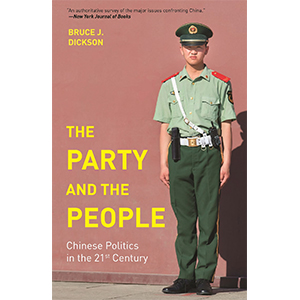
The Party and the People: Chinese Politics in the 21st Century
Since 1949, the Chinese Communist Party (CCP) has maintained unrivaled control over the country, persisting even in the face of economic calamity, widespread social upheaval, and violence against its own people. Yet the party does not sustain dominance through repressive tactics alone—it pairs this with surprising responsiveness to the public. The Party and the People explores how this paradox has helped the CCP endure for decades, and how this balance has shifted increasingly toward repression under the rule of President Xi Jinping.
Delving into the tenuous binary of repression and responsivity, Bruce Dickson illuminates numerous questions surrounding the CCP’s rule: How does it choose leaders and create policies? When does it allow protests? Will China become democratic? Dickson shows that the party’s dual approach lies at the core of its practices—repression when dealing with existential, political threats or challenges to its authority, and responsiveness when confronting localized economic or social unrest. The state answers favorably to the demands of protesters on certain issues, such as local environmental hazards and healthcare, but deals harshly with others, such as protests in Tibet, Xinjiang, or Hong Kong. With the CCP’s greater reliance on suppression since Xi Jinping’s rise to power in 2012, Dickson considers the ways that this tipping of the scales will influence China’s future.
Bringing together a vast body of sources, The Party and the People sheds new light on how the relationship between the Chinese state and its citizens shapes governance.
RM115.50
Out of stock
Description
Since 1949, the Chinese Communist Party (CCP) has maintained unrivaled control over the country, persisting even in the face of economic calamity, widespread social upheaval, and violence against its own people. Yet the party does not sustain dominance through repressive tactics alone—it pairs this with surprising responsiveness to the public. The Party and the People explores how this paradox has helped the CCP endure for decades, and how this balance has shifted increasingly toward repression under the rule of President Xi Jinping.
Delving into the tenuous binary of repression and responsivity, Bruce Dickson illuminates numerous questions surrounding the CCP’s rule: How does it choose leaders and create policies? When does it allow protests? Will China become democratic? Dickson shows that the party’s dual approach lies at the core of its practices—repression when dealing with existential, political threats or challenges to its authority, and responsiveness when confronting localized economic or social unrest. The state answers favorably to the demands of protesters on certain issues, such as local environmental hazards and healthcare, but deals harshly with others, such as protests in Tibet, Xinjiang, or Hong Kong. With the CCP’s greater reliance on suppression since Xi Jinping’s rise to power in 2012, Dickson considers the ways that this tipping of the scales will influence China’s future.
Bringing together a vast body of sources, The Party and the People sheds new light on how the relationship between the Chinese state and its citizens shapes governance.
Publisher: Princeton University Press
Paperback
2023
ISBN: 9780691216973
Related products
-

Contemporary Islamic Discourse in the Malay–Indonesian World: Critical Perspectives
While many books have probed the role of Islam in political and social change in Southeast Asia over the past three decades, few have focused on the...RM50.00 -

A Strangeness in My Mind
A Strangeness In My Mind is a novel Orhan Pamuk has worked on for six years It is the story of boza seller Mevlut, the woman to whom he wrote three...RM72.50 -

Being Dutch in the Indies: A History of Creolisation and Empire, 1500–1920
Being Dutch in the Indies portrays Dutch colonial territories in Asia not as mere societies under foreign occupation but rather as a Creole empire...RM100.00 -

Banana Punk Rawk Trails: A Euro-Fool’s Metal Punk Journeys in Malaysia, Borneo and Indonesia
Between 2010 and 2015, travel writer, author and metal punk guitarist Marco Ferrarese was the one and only ‘white elephant in the room’ of the...RM48.00