
 Footsteps
 Gun Island

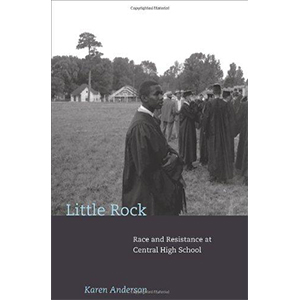
Little Rock: Race and Resistance at Central High School
The desegregation crisis in Little Rock is a landmark of American history: on September 4, 1957, after the Supreme Court struck down racial segregation in public schools, Arkansas Governor Orval Faubus called up the National Guard to surround Little Rock Central High School, preventing black students from going in. On September 25, 1957, nine black students, escorted by federal troops, gained entrance. With grace and depth, Little Rock provides fresh perspectives on the individuals, especially the activists and policymakers, involved in these dramatic events. Looking at a wide variety of evidence and sources, Karen Anderson examines American racial politics in relation to changes in youth culture, sexuality, gender relations, and economics, and she locates the conflicts of Little Rock within the larger political and historical context.
Anderson considers how white groups at the time, including middle class women and the working class, shaped American race and class relations. She documents white women’s political mobilizations and, exploring political resentments, sexual fears, and religious affiliations, illuminates the reasons behind segregationists’ missteps and blunders. Anderson explains how the business elite in Little Rock retained power in the face of opposition, and identifies the moral failures of business leaders and moderates who sought the appearance of federal compliance rather than actual racial justice, leaving behind a legacy of white flight, poor urban schools, and institutional racism.
Probing the conflicts of school desegregation in the mid-century South, Little Rock casts new light on connections between social inequality and the culture wars of modern America.
RM65.00
1 in stock
Description
The desegregation crisis in Little Rock is a landmark of American history: on September 4, 1957, after the Supreme Court struck down racial segregation in public schools, Arkansas Governor Orval Faubus called up the National Guard to surround Little Rock Central High School, preventing black students from going in. On September 25, 1957, nine black students, escorted by federal troops, gained entrance. With grace and depth, Little Rock provides fresh perspectives on the individuals, especially the activists and policymakers, involved in these dramatic events. Looking at a wide variety of evidence and sources, Karen Anderson examines American racial politics in relation to changes in youth culture, sexuality, gender relations, and economics, and she locates the conflicts of Little Rock within the larger political and historical context.
Anderson considers how white groups at the time, including middle class women and the working class, shaped American race and class relations. She documents white women’s political mobilizations and, exploring political resentments, sexual fears, and religious affiliations, illuminates the reasons behind segregationists’ missteps and blunders. Anderson explains how the business elite in Little Rock retained power in the face of opposition, and identifies the moral failures of business leaders and moderates who sought the appearance of federal compliance rather than actual racial justice, leaving behind a legacy of white flight, poor urban schools, and institutional racism.
Probing the conflicts of school desegregation in the mid-century South, Little Rock casts new light on connections between social inequality and the culture wars of modern America.
Publisher: Princeton University Press
Paperback
2013
ISBN: 9780691159614
Related products
-

The Money Changers: A Guided Tour Through Global Currency Markets
Currency markets, worth almost $2 trillion per day in trade, link the world together Yet few people know how they work and why they are prone to...RM15.00 -

Ask For No Bullshit, Get Some More!
No-nonsense writer Kee Thuan Chye is back exposing more bullshit in the Malaysian political realm His pen is as sharp as ever as he slices the lies...RM35.00 -

Migration, Health And Inequality
Should migrants have the same rights as citizens to health care services What do we mean by rights and by health And how do we uphold such rights...RM100.00 -

Environment & Citizenship: Intergrating Justice, Responsibility And Civic Engagement
Stock exchange implosions, flights of capital, currency collapses, investment scams, tax evasion, and now terrorists hiding their funds in offshore...RM90.00